2006 winner: Thomas Heatherwick
The man behind work including the Rolling Bridge at Paddington Basin, the B of the Bang sculpture in Manchester and the Sitooterie at Essex received the award from HRH the Duke of Edinburgh in a ceremony at the Design Council in London.
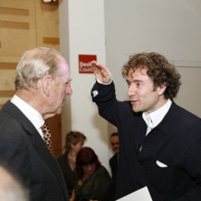 At only 36, Heatherwick is the youngest ever winner of the prize, which recognises a lasting contribution to design for business and society. He said: ‘It’s quite odd, but really flattering. It seemed ridiculous that I might actually win it because it was an amazing shortlist of nominees.’
This year’s contenders also included influential textile designer Lucienne Day and David Mellor, whose name has become synonymous with quality in the design and manufacture of cutlery. Both received a Special Commendation.
The other nominees were architect Richard Rogers, passenger ship designer Stephen Payne, and furniture designer Rodney Kinsman.
 After the ceremony, Heatherwick spoke about the origins of his successful studio: ‘There were two or three of us when we finished at the Royal College of Art. We worked from where I lived, so if a client came for a meeting, I had to make my bed and clean the crumbs off the circular saw.
‘Over the years we have attracted some really fantastic people with different backgrounds, aptitudes and interests. In a way, I act as a middle point, pulling all this creativity together and then trying to shape what a project should be using everyone’s ideas.’
Heatherwick has been compared to Leonardo Da Vinci and described as a polymath, a maverick and a cross between Brunel, Spielberg and Conran, but he doesn’t agree that his work defies categorisation. ‘I find it interesting that it seems to be a big deal. I feel I do specialise in three-dimensional work with my studio – we don’t do 2d, we don’t do film, we don’t do theatre.’
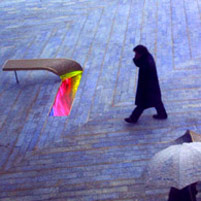 Asked what he found most challenging, he said; ‘Designing built environments is the hardest because it ranges from the smallest scale product, such as door furniture right up to the larger scale - how a city works or the environmental performance of a building; when I wrote my thesis 15 or 16 years ago about the training an architect gets, I started to realise how hard it is to get a building built at all, let alone something that works well, works to a budget and has any aesthetic qualities.’
It’s an exciting time for Heatherwick and his studio, with several large projects in the pipeline. They include the transformation of an existing building into a public building and retail outlet in Hong Kong. ‘It’s like a gigantic aircraft carrier, a whole little town, and there are four skyscrapers that sit on top. It’s a very public route through the city so we’ve been interested in how to make profound changes and that’s something that 12 people in the studio are working on at the moment. We’re in the thick of it.’
The Prince Philip Designers Prize is awarded annually by the Design Council to recognise a career which has upheld the highest standards and broken new ground, while raising the status of design in business and the public sector and also contributing to design education. Nominees and judges for the prize are put forward by professional and educational bodies.
Lucienne Day OBE RDI - Special commendation
 Lucienne Day is arguably the most revered and influential British textile designer of the 20th century. She helped to define the modern aesthetic which revitalised British design in the post-war period, and her work has been marked by commitment to the belief that accessible, affordable design improves quality of life.
Lucienne came to prominence with the revolutionary and widely acclaimed Calyx furniture fabric, printed by Heals and created for the Festival of Britain in 1951. Work for the likes of Edinburgh Weavers and Liberty followed, and Lucienne’s motifs and use of colour saw her influence extend in to other fields including wallpaper, ceramics and carpets. The durability of Lucienne’s work is underlined by recent exhibitions and reproductions of her most iconic designs by retailer twentytwentyone and Glasgow Schools of Art’s Centre for Advanced Textiles.
David Mellor CBE RDI - Special commendation
 David Mellor’s name is synonymous with quality in the design and manufacture of cutlery. He has produced numerous classic designs, perhaps the best-known being his Pride range, launched in the 1950s, still in production today and in use worldwide.
David’s commitment to excellence has made him a standard bearer for the traditional cutlery industry in Sheffield. But his versatility has seen him extended further. Driven by a passion for design for the public good, which was rooted in his training during the Festival of Britain era, his designs for park benches, street lighting, traffic lights and bus shelters have made an impact on innumerable people’s lives. David has been chairman of the Crafts Council and a trustee of the Victoria & Albert Museum, also teaching at Sheffield College of Art and the Royal College of Art.
Rodney Fitch CBE
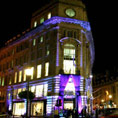 Rodney Fitch has played a key role in the evolution of retail design and has helped to embed awareness among businesses of the commercial impact of design. In the process, he has also made a huge contribution to the British design industry and its standing both at home and abroad.In 1972 Rodney founded his own consultancy, which went on to become one of the UK’s largest and best-known, with multiple studios in 12 countries. It provides retail, product and brand design and realises nearly £50m annual fee income – 85 per cent of it from overseas. Clients include Microsoft, Apple and Boeing.
Alongside his commercial success, Rodney is a committed supporter of design education. Until 2005 he was Deputy Chairman of the London Institute, which he helped to found.
Rodney Kinsman RDI
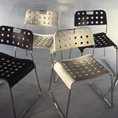 For 40 years, Rodney Kinsman has been among the most consistently successful British furniture designers, turning his own designs into best selling products through his own company, OMK.
His work is characterised by a cool rationalism, precision and practicality – qualities that have made him a particularly successful designer of public seating systems. The Trax system, designed in 1990 for international airports, is still the market leader, in part because the design has the built-in flexibility to evolve over time.
Other work includes the T1 chair, designed in 1966 at the start of a 20-year relationship with Habitat, and the Omstak stacking chair, in constant production for 30 years and part of numerous museums’ permanent 20th century collections. He is Visiting Professor and a Governor of University of the Arts London.
Stephen Payne OBE
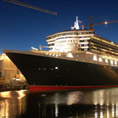 Primarily known for his innovative work on the Queen Mary 2 cruise liner, Stephen Payne is the world’s leading passenger ship designer.
Inspired by a boyhood fascination with the Queen Elizabeth liner, he achieved his ambition to become a naval architect in 1985, joining London-based Technical Marine Planning. Stephen was soon given responsibility for significant new design programmes and when his employer’s parent company Carnival acquired Cunard in 1998 he was given the task of designing the replacement for the ageing QE2. The result was QM2. Stephen’s achievement was to offset the £550million cost of producing a genuine trans-Atlantic liner by designing a ship that would deliver a passenger experience memorable enough to guarantee full booking for every crossing.
Richard Rogers
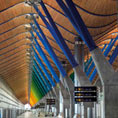 Richard Rogers is one of a handful of British architects whose work has a worldwide resonance and reputation. His design innovation and sophisticated political thinking have helped ensure a high public profile for the work that architects do.
His startlingly radical approach announced itself in 1976 with the Centre Pompidou in Paris, which has attracted 100 million visitors. Richard Rogers Partnership has subsequently produced a series of inspiring, thoughtful and award-winning buildings across the world, including the Lloyds of London Building, the European Court of Human Rights in Strasbourg and Bajaras Airport, Madrid, completed in 2005, which won this year’s Stirling Prize.
Richard is the government’s chief advisor on urban regeneration and Chief Advisor on Architecture and Urbanism to the Mayor of London. He has also been Chairman of the Tate Gallery and Deputy Chairman of the Arts Council.
History
The Prince Philip Designers Prize has been running since 1990, with the exception of the years 1995 and 1996. It recognises outstanding lifetime achievement in design for business and society. It replaces a previous award which started out as the Duke of Edinburgh's Prize for Elegant Design in 1959.
Nominations
The prize is awarded to an individual designer or a leader of a design team, selected from nominations by the following organisations:
Design Council, Arts Council, D&AD, Design Business Association, Design and Industries Association, Design Museum, Engineering Council, Engineering Employers Federation, Engineering and Technology Board, Institution of Engineering Designers, Royal College of Art, Royal Institute of British Architects, Royal Society of Arts.
Nominations are sought in April each year, to be received by June. Selection takes place in October and the prize is awarded in November.
Judging criteria
Selection criteria for the Prince Philip Designers Prize take the following into account:
- Contribution to the perception of design by industry and the public, and to the status of designers
- Influence on design standards and trends
- Record of successful design for consumer and industrial products or buildings, especially success in the marketplace
- Originality of concepts, patents and other Intellectual Property Rights
- Aesthetic quality of designs
- Structural, manufacturing or engineering quality of design
- Contribution to design education.
Judges
The selection panel is chaired every year by H.R.H. The Duke of Edinburgh.
Individual members of the panel are appointed for a period of five years and will be nominated by the Design Council, the Royal Designers for Industry, the Chartered Society of Designers, the Confederation of British Industry and the Royal Academy of Engineering.
Members of the panel are chosen from professional design practitioners and people known to have an understanding and appreciation of design. The appointment of members is arranged so that one new member will be appointed and the member who has completed five years will retire each year.
This year, the panel comprised:
Sir George Cox, Chairman of the Design Council
Mike Dempsey RDI, nominated by the Royal Designers for Industry
David Godber, nominated by the Design Council
John Sermon, nominated by the Chartered Society of Designers
Dr Scott Steedman, nominated by the Royal Academy of Engineering
Martin Stevens, nominated by the Confederation of British Industry
Prizes
The winner of the Prince Philip Designers Prize will be presented personally with a signed certificate by Prince Philip. The selection panel may award 'Specially Commended Certificates' to a limited number of other candidates.
Previous winners
Previous winners of the Prince Philip Designers Prize include architect Sir Michael Hopkins and graphic designer Derek Birdsall.
Find a list of previous winners here.